 pdf
pdf
Published
2026-08-03
Section
Regular Issues
License
Copyright (c) 2026 Artha: Journal of Business and Finance

This work is licensed under a Creative Commons Attribution-NonCommercial-NoDerivatives 4.0 International License.
How to Cite
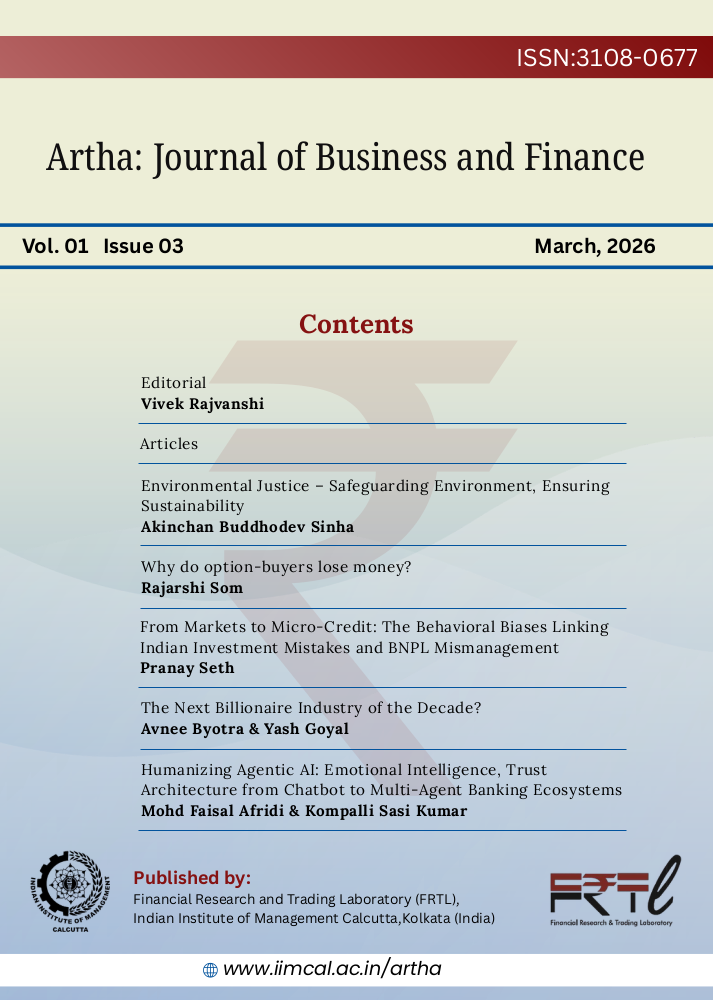
Humanizing Agentic AI: Emotional Intelligence, Trust Architecture from Chatbot to Multi-Agent Banking Ecosystems
Mohd Faisal Afridi
Kompalli Sasi Kumar
Keywords: AI Chatbot Adoption, Indian Retail Banking, UTAUT Extension, Service Challenges, Institutional Trust
Abstract
The adoption of AI chatbots in the banking sector is a critical issue despite the high numbers of AI
chatbots deployed in the sector. In this mixed-method research, study explore about technological
sophistication triggers human frustration in Indian retail banking by sequentially applying exploratory
research design, involving qualitative analysis of 19,858 customer complaints and quantitative
validation of the hypothesis with 1,000 banking customers using a PLS-SEM. The study builds on the
UTAUT model by incorporating AI-specific constructs such as emotional intelligence,
anthropomorphism and privacy capabilities to study adoption barriers. Results show that AI
Effectiveness or effort expectancy turns out to be the central predictor and is even more significant than performance expectancy but does not mean that performance expectancy is not essential. The effect size of effort is approached by two variables, trust and privacy capabilities and the hypothesis on the privacy paradox which try to measure the consumer can share data over performance and efforts ease is rejected. The qualitative analysis reveals the negative sentiment and complaints focus on the operational breakdowns related based on thematic analysis (40 percent), technological shortcomings (25 percent), and loss of trust (15 percent). These Challenges are the outcome of the existing banking chatbot realities banking operation and branch services together with many minor challenges do exist that were uncovered in the qualitative analysis such lingual difference and other. The model so proposed has very good explanatory power (R 2 =0.639 intention, R 2 =0.443 behavior) as well as very good predictive validity (Q 2 predict=0.630). The results show that effortlessness is replacing usefulness in the generative AI age as the key driver of adoption, which requires fundamental re- architecturalization to multi-agent orchestration with tiered human-supervised autonomy instead of slow chatbot incremental improvements.
Author Biographies
Mohd Faisal Afridi, GITAM University
Mohd Faisal Afridi, GITAM UniversityMohd Faisal Afridi is a PhD candidate in Financial Management at GITAM University, Hyderabad, and Founder of Insight Data Analytics. His research focuses on AI in banking, privacy paradox, ESG performance, and trust in digital financial ecosystems. He holds an MBA in Marketing and Finance and a B.Tech, with industry experience in banking and expertise in financial systems and data analytics. His work has been published in ABDC-listed and Scopus-indexed journals and presented at leading institutions, contributing to trust-centered, AI-driven financial innovation.
Kompalli Sasi Kumar, GITAM University
Kompalli Sasi Kumar, GITAM School of BusinessDr. Kompalli Sasi Kumar is an Associate Professor in Accounting and Finance at GITAM School of Business, Hyderabad, with over 22 years of academic and industry experience. His research areas include financial econometrics, investment management, banking, behavioral finance, ESG performance, and research methodology. He has published 30+ papers in peer-reviewed journals and presented at leading national and international institutions. Dr. Kumar also conducts FDPs and MDPs in analytics tools and research methods, has authored multiple books in finance-related domains, and actively supervises doctoral research.