 pdf
pdf
Published
2026-07-27
Section
Regular Issues
License
Copyright (c) 2026 Artha: Journal of Business and Finance

This work is licensed under a Creative Commons Attribution-NonCommercial-NoDerivatives 4.0 International License.
How to Cite
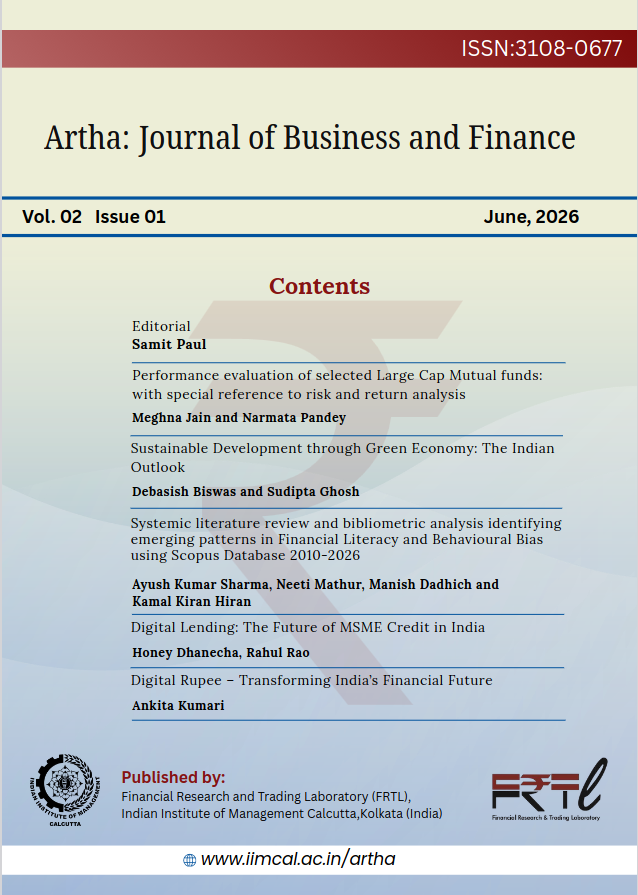
Digital Lending: The Future of MSME Credit in India
Honey Dhanecha
Rahul Rao
Keywords: Digital lending, MSME credit, NBFCs, FinTech, Unified Payments Interface (UPI), Account Aggregator
Abstract
Micro, Small, and Medium Enterprises (MSMEs) hold criti- cal significance in the growth of Indian economy, yet persis- tent credit constraints limit their growth and competitiveness. Over the past few years, the convergence of digital payments (particularly the Unified Payments Interface, [UPI]) FinTech innovation and digital public infrastructure (DPI) have revo- lutionized MSME financing in India. This article offers a pol- icy-oriented review of India’s evolving digital lending eco- system, with a focus on the role of FinTech-NBFC partner- ships, alternative data-driven of credit assessment and emerg- ing frameworks such as the Unified Lending Interface (ULI), Open Credit Enablement Network (OCEN) and the Account Aggregator (AA) ecosystem. Drawing on secondary data from regulatory institutions, multilateral organizations and industry reports, the paper synthesizes recent developments in digital lending and MSME credit delivery during the period of 2016-2025. Furthermore, the analysis suggests that digital- ization has the potential to reduce information asymmetries and transaction costs, thereby expanding access to formal credit for Indian MSMEs. However, issues of data privacy, regulatory coordination and governance remain pertinent. The article concludes that while digital lending offers a prom- ising solution to bridge the credit deficit for Indian MSMEs, its long-term effectiveness will depend on the development of adaptive, robust and interoperable regulatory frameworks that foster innovation and contribute to a more efficient and inclusive financial ecosystem.
Author Biographies
Honey Dhanecha, Ahmedabad University
Honey Jagdish Dhanecha is an undergradu- ate student pursuing a Bachelor’s in Busi- ness Administration (Honours) at Ahmeda- bad University, with a major in Marketing and a minor in Finance and Economics. Her research interests lie at the intersection of digital finance, behavioural economics, and economic develop- ment, with a particular focus on emerging financial ecosystems and consumer behaviour.
Rahul Rao, Ahmedabad University
Rahul Rao is a macroeconomist. He studies the role of market imperfections in affecting aggregate outcomes for an economy. His current research work spans the following subfields of macroeconomics: monetary, fi- nancial and spatial economics. He is cur- rently serving as an Assistant Professor of economics at the Amrut Mody School of Management, Ahmed- abad University. He has completed his PhD in economics from IIM Bangalore and had graduated from IIT Kanpur with a BTech degree in Electrical Engineering.
References
Angre, Alekh. 2025. “Non-bank Lenders ‘LAP’ up Oppor- tunity to Tap MSMEs.” The Economic Times, May 17, 2025. https://economictimes.indiatimes.com/industry/banking/fi-nance/non-bank-lenders-lap-up-opportunity-to-tap-msmes/ar-ticleshow/121219333.cms?from=mdr.
Asian Development Bank. 2025. “2025 Asia Small and Me- dium-Sized Enterprise Monitor.” 2025. https://data.adb.org/da- taset/2025-asia-small-and-medium-sized-enterprise-monitor.
Balakrishnan, Bama, and Satya Srinivasan. 2019. “What Makes NBFCs a Better Choice for Lending to MSME Sector.” The Economic Times, July 5, 2019. https://economictimes.indi- atimes.com/markets/stocks/news/what-makes-nbfcs-a-better- choice-for-lending-to-msme-sector/arti- cleshow/70082947.cms?from=mdr.
Bera, Ayanti. 2025. “ULI Facilitated Over 1.4 Million Loans Worth Rs 65K Crore, Says RBI.” Financial Express, April 22, 2025. http://financialexpress.com/business/banking-fi- nance/uli-facilitated-over-1-4-million-loans-worth-rs-65k- crore-says-rbi/3818576/.